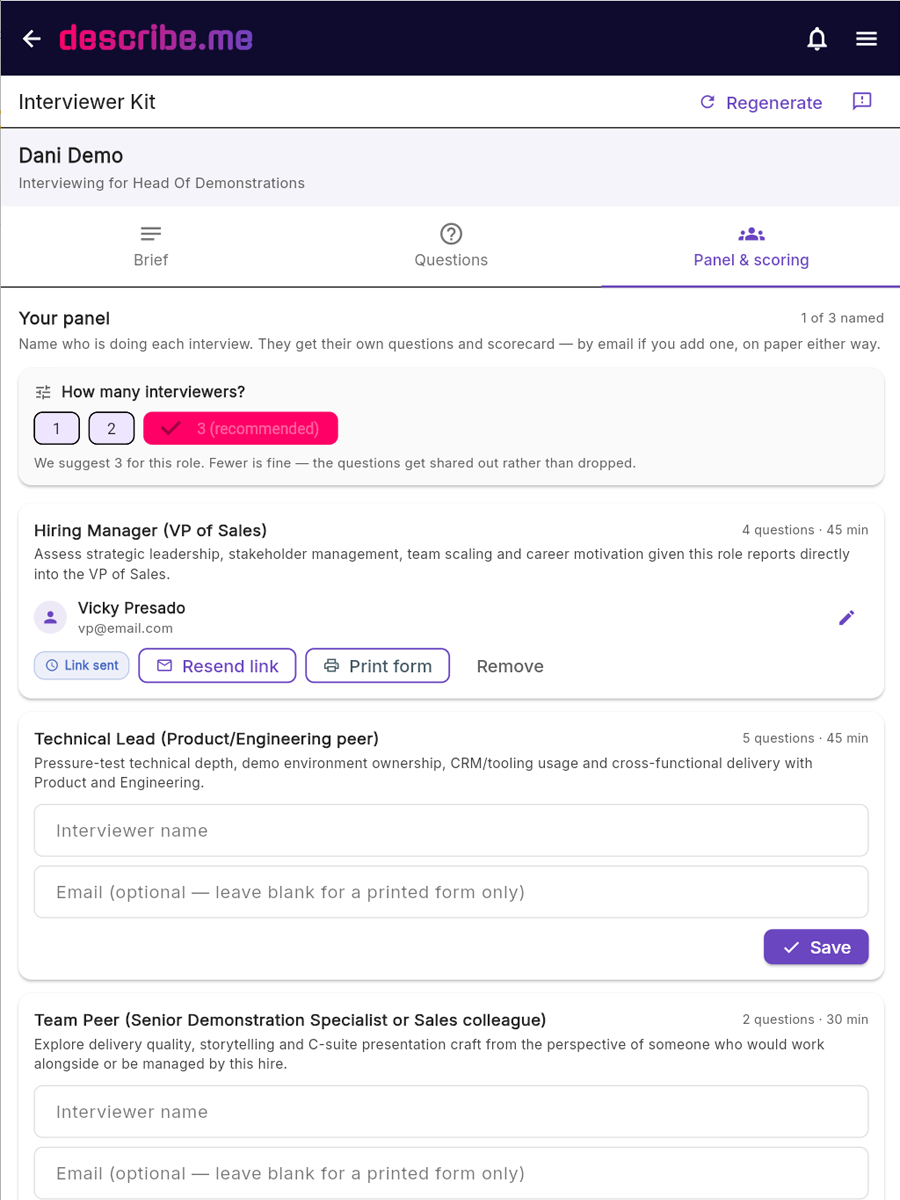
When you unlock someone, describe.me writes the interview for that person on that role — weighted towards the skills we could not verify. Then it splits the questions across your panel and gives each interviewer a scorecard to fill in.
See your matches — free How hiring direct works →A generic list asks a career-changer and a fifteen-year specialist to answer identically. You learn what they have in common, not what sets them apart.
Without a plan, everyone opens with the same warm-up and covers the same ground. You spend three hours of company time triple-checking one thing.
Without a shared scorecard the debrief becomes whoever argues hardest. Good candidates lose to confident ones, and you cannot explain the decision afterwards.
Every other question generator starts from the role title. Ours starts from the matching work we have already done on this specific person: for each thing the role needs, we know whether their work history actually backs it up.
Before the questions, a short brief on who you are about to meet and what is genuinely unresolved — written from their history against your role, not from their CV summary.
Ten to fourteen questions, each one traceable to something real. Open any of them to see why it is being asked, what a strong answer actually contains, and where to push if the first answer stays abstract.
The questions are split across your panel so nobody doubles up, and every interviewer gets a weighted scorecard with proper descriptions of what a 1, a 3 and a 5 look like. The debrief becomes a comparison, not a debate.
Interviewer Kits appear for any candidate your company has unlocked, on any role they match.
One tap. The brief, questions, panel split and scorecard are built from the role and that candidate’s history.
Say who is doing each interview. They get their own questions by email, or a printed form — your choice.
Everyone scores against the same criteria. You get one weighted view of the panel instead of three opinions.
Every question is grounded in something concrete: a skill the role requires, a requirement in your role description, something in the candidate’s actual work history, or a retention signal. They weight towards essential skills the candidate has listed but that we could not corroborate — that is where an interview adds the most.
No. Each panel member gets their own link by email with their questions and their scorecard. No signup, no login. Anyone who would rather write on paper can be handed a printed form instead.
The panel is a recommendation, not a requirement. Choose one, two or three and the questions are shared out across whoever you actually have — every question still gets asked, just by fewer people.
You can regenerate the whole kit as often as you like, and rename the panel roles to match your team. Scores already submitted against criteria that survive a regeneration are kept.
No, and the kit never says so. It means we could not corroborate that skill from their work history — plenty of strong people keep thin profiles. It is a prompt to ask for a worked example, not a judgement on the person.
Nothing extra. The Interviewer Kit is included once you have unlocked a candidate’s contact details. See our pricing — you pay per contact, and your first three are free.
Write the role · Match the people · Back the ones who’ll stay · Get them in the room · Know what to ask
Give us a title and we write the role description, pre-filled from the live market.
Tighten the role against the live market before you match.
Multi-layer matching surfaces and ranks the right people.
The 60-second, shareable case for every candidate.
Score who’ll accept, stay and thrive — not just look good today.
From shortlist to booked interview, without a scheduling email.
Start with a free, anonymised shortlist for your role. Unlock anyone you want to meet — the Interviewer Kit comes with them.
See your matches — free